
The science
Aging is a network.
Energy production, inflammatory signaling, immune balance, oxidative balance, and tissue repair don’t age in isolation. Each influences the others, which is why support for one system alone may be incomplete.
Aging is a network
Connected systems, changing together.
Changes in one system ripple into others. Lower cellular energy affects repair; persistent inflammatory signaling affects energy, cognition, and tissue maintenance.
- Cellular energy
- Mitochondrial health
- Inflammatory balance
- Immune signaling
- Brain & nerve health
- Oxidative balance
- Tissue repair
A lifetime process
Four stages. One network.
Puppy
Build the foundation.
Growth is one of the most biologically demanding periods of life. Supporting cellular energy, membrane health, immune balance, and resilience early helps build the foundation for the years ahead.
Support the foundationSystems that matter most
- Rapid growth
- Immune development
- Neurological development
- Mitochondrial development
- Oxidative demands
- Resilience
Why daily support may matter
Fast-growing tissue and a developing brain place high demands on cellular energy and membranes.
How Quelle365 fits
DHA supports developing brain-cell membranes, while astaxanthin and quercetin support oxidative balance during growth.
Different stage. Same network. Different priorities.
López-Otín et al., Cell, 2023
The 12 Hallmarks of Aging.
Select any Hallmark on the wheel or from the list to see the plain-English explanation, related ingredients, proposed connection, and evidence category.
Explore by life stage
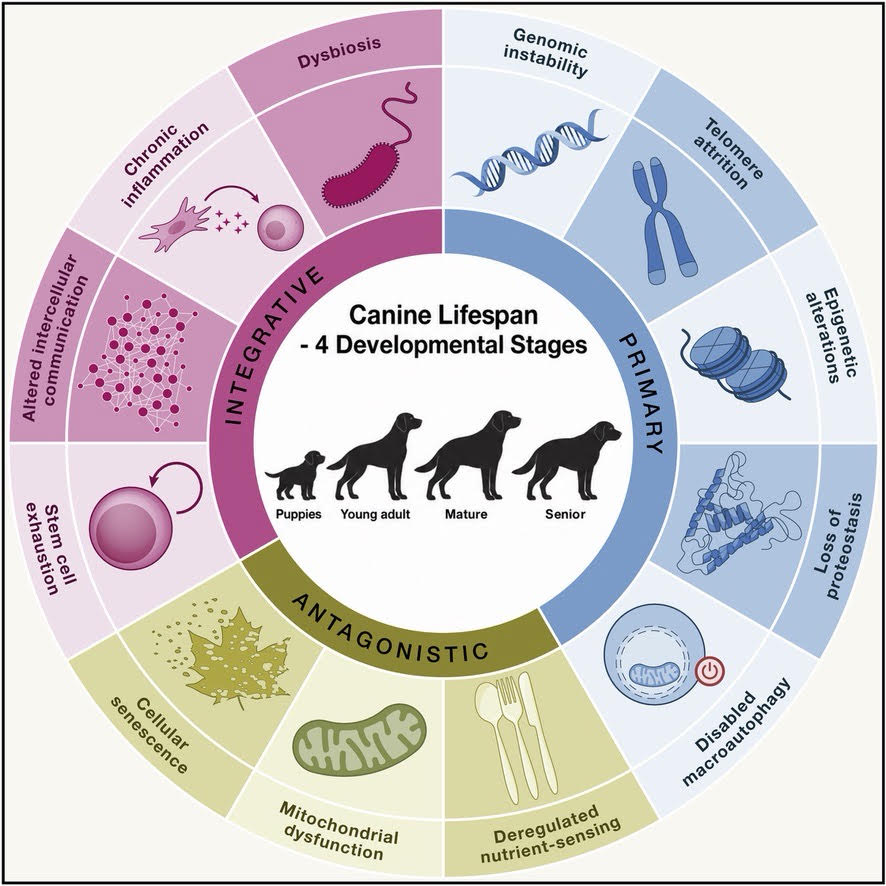
Hallmark 11 of 12
Chronic inflammation
Scientific category: Integrative · whole-body effects
“Inflammaging”: low-grade inflammatory signaling that can build from middle age and later show up as stiffness, itchy skin, or cloudy thinking.
Related Quelle365 ingredients
- Ultramicronized PEA
- Beta-caryophyllene
- Quercetin
- Astaxanthin
- DHA
Proposed biological connection
All five ingredients are connected here: PEA and BCP support calm tissue signaling, quercetin and astaxanthin support balance during flare-ups, and DHA supports the body’s own resolution biology.
Evidence category
- Canine evidence· Studied in dogs
- Animal model· Studied in laboratory animals
- Cellular / mechanistic· Studied in cells or pathways
Life-stage emphasis
Mature · Senior · Most relevant as aging progresses
Ingredient links reflect published research on the individual ingredients. The finished Quelle365™ formula has not itself been clinically tested against each Hallmark of Aging.
The longevity network
Research pathways behind the formula.
These are research pathways associated with individual ingredients in published studies, not clinical outcomes of the finished product.
SIRT1
Master switch for cellular maintenance
Studied with: Quercetin, Beta-caryophyllene
AMPK
Cellular fuel sensor
Studied with: Astaxanthin, PEA
PGC-1α
Builds new mitochondria
Studied with: Astaxanthin, Quercetin
Nrf2
Antioxidant defense switch
Studied with: Astaxanthin
FOXO3
Longevity-associated gene
Studied with: Astaxanthin
NF-κB
Inflammatory signaling hub
Studied with: PEA, Beta-caryophyllene
PPAR-α
Lipid & inflammatory regulation
Studied with: PEA
SPMs
Specialized pro-resolving mediators
Studied with: DHA
The eCSEPTIONOL® Formula
The five ingredients.
- PEA
Ultramicronized PEA
Palmitoylethanolamide
Supports healthy inflammatory and neuroimmune signaling
A fatty-acid amide the body already makes to help calm irritated tissue. Ultramicronized PEA has been studied in dogs for skin and joint comfort, and in models of brain aging.
- PPAR-α
- AMPK
- Mast-cell & microglial signaling
- BCP
Beta-caryophyllene
From cloves & rosemary
Supports cellular signaling and inflammatory balance
A food-grade, non-psychoactive plant compound that engages the CB2 receptor. Research models link it to SIRT1 signaling and stress-response genes.
- CB2
- SIRT1
- Stress-response genes
- DHA
DHA
Omega-3 fatty acid
Supports brain-cell membranes and healthy resolution biology
A structural fat in brain and retina cell membranes, and the precursor to specialized pro-resolving mediators (SPMs) that help the body resolve inflammation.
- SPMs
- Membrane fluidity
- Telomere–mitochondria axis
- ASX
Astaxanthin
From microalgae
Supports oxidative balance and mitochondrial resilience
The carotenoid that gives salmon its color. A 2024 NIA Interventions Testing Program study reported extended median lifespan in male mice.
- Nrf2
- AMPK / FOXO3 / Klotho
- PGC-1α
- QUE
Quercetin
From apples & onions
Supports cellular stress responses and energy-signaling pathways
A dietary flavonoid studied for mitochondrial biogenesis in neuronal cells and as a senolytic compound in cell models.
- NAD / SIRT1
- PGC-1α
- Senescence pathways
Evidence levels
Not all evidence is equal.
We label every connection so you can judge it for yourself. Ordered from most to least directly applicable to dogs.
- Canine evidenceStudied in dogs
- Human evidenceStudied in people
- Animal modelStudied in laboratory animals
- Cellular / mechanisticStudied in cells or pathways
- Network-level rationaleInferred from connected pathways
References
Peer-reviewed literature.
Hallmarks framework
- López-Otín C, et al. Hallmarks of Aging: An Expanding Universe. Cell. 2023;186(2):243–78. doi.org/10.1016/j.cell.2022.11.001
PEA
- Scuderi C, Golini L. Successful and Unsuccessful Brain Aging in Pets… Palmitoylethanolamide Nutritional Intervention. Animals. 2021;11(9):2584. doi.org/10.3390/ani11092584
- Bellanti F, et al. Effects of Ultramicronized Palmitoylethanolamide on Mitochondrial Bioenergetics, Cerebral Metabolism, and Glutamatergic Transmission. Front Aging Neurosci. 2022;14:890855. doi.org/10.3389/fnagi.2022.890855
Beta-caryophyllene
- Pant A, et al. Beta-caryophyllene modulates expression of stress response genes and mediates longevity in Caenorhabditis elegans. Exp Gerontol. 2014;57:81–95. doi.org/10.1016/j.exger.2014.05.007
- Ricardi C, et al. Multi-target Protective Effects of β-caryophyllene at the Intersection of Neuroinflammation and Neurodegeneration. Int J Mol Sci. 2025;26(13):6027. doi.org/10.3390/ijms26136027
DHA
- Wu S, et al. Lifelong docosahexaenoic acid intervention ameliorates aging in the telomere-DNA-mitochondria axis in telomerase-deficient mice. J Nutr Biochem. 2023;112:109202. doi.org/10.1016/j.jnutbio.2022.109202
Astaxanthin
- Harrison DE, et al. Astaxanthin and meclizine extend lifespan in UM-HET3 male mice. GeroScience. 2024;46(1):795–816. doi.org/10.1007/s11357-023-01011-0
- Sorrenti V, et al. Astaxanthin as a Putative Geroprotector: Molecular Basis and Focus on Brain Aging. Marine Drugs. 2020;18(7):351. doi.org/10.3390/md18070351
Quercetin
- Ho CL, et al. Quercetin Increases Mitochondrial Biogenesis and Reduces Free Radicals in Neuronal SH-SY5Y Cells. Nutrients. 2022;14(16):3310. doi.org/10.3390/nu14163310
- Zoico E, et al. Senolytic effects of quercetin in an in vitro model of pre-adipocytes and adipocytes induced senescence. Sci Rep. 2021;11(1):23237. doi.org/10.1038/s41598-021-02544-0
Cognition & inflammatory biology
- Ponce J, et al. Role of specialized pro-resolving mediators in reducing neuroinflammation in neurodegenerative disorders. Front Aging Neurosci. 2022;14:780811. doi.org/10.3389/fnagi.2022.780811
- Franck M, et al. Inflamm-aging as a diverse and context-dependent process. Ageing Res Rev. 2025:102880. doi.org/10.1016/j.arr.2025.102880